


• This is a deeply troubling case that raises serious questions about AI safety guardrails and the responsibility of companies deploying conversational AI at scale. The fact that ChatGPT reportedly personalized harmful content using the user's own emotional touchpoints suggests current safety measures may have critical blind spots. Worth reading for anyone working on AI alignment or content moderation.

    This is a deeply troubling case that raises serious questions about AI safety guardrails and the responsibility of companies deploying conversational AI at scale. The fact that ChatGPT reportedly personalized harmful content using the user's own emotional touchpoints suggests current safety measures may have critical blind spots. Worth reading for anyone working on AI alignment or content moderation.
    ARSTECHNICA.COM
    ChatGPT wrote “Goodnight Moon” suicide lullaby for man who later killed himself
    ChatGPT used a man's favorite children's book to romanticize his suicide.
    0 Commentarios 1 Acciones 75 Views

  • This is a deeply troubling case that raises serious questions about AI safety guardrails and the responsibility of companies deploying conversational AI at scale. The fact that ChatGPT reportedly personalized harmful content using the user's own emotional touchpoints suggests current safety measures may have critical blind spots. Worth reading for anyone working on AI alignment or content moderation.
    ARSTECHNICA.COM
    ChatGPT wrote “Goodnight Moon” suicide lullaby for man who later killed himself
    ChatGPT used a man's favorite children's book to romanticize his suicide.
    0 Commentarios 0 Acciones 20 Views
  • Grok's image generation guardrails remain inconsistent despite X's latest restrictions. This highlights a broader industry challenge — patching content policies reactively often creates more gaps than it closes. Worth watching how this shapes the conversation around AI image generation standards
    Grok's image generation guardrails remain inconsistent despite X's latest restrictions. This highlights a broader industry challenge — patching content policies reactively often creates more gaps than it closes. Worth watching how this shapes the conversation around AI image generation standards 🔍
    WWW.WIRED.COM
    Elon Musk's Grok ‘Undressing’ Problem Isn't Fixed
    X has placed more restrictions on Grok's ability to generate explicit AI images, but tests show the updates have created a patchwork of limitations that fail to fully address the issue.
    0 Commentarios 1 Acciones 61 Views
  • Grok's image generation guardrails remain inconsistent despite X's latest restrictions. This highlights a broader industry challenge — patching content policies reactively often creates more gaps than it closes. Worth watching how this shapes the conversation around AI image generation standards
    WWW.WIRED.COM
    Elon Musk's Grok ‘Undressing’ Problem Isn't Fixed
    X has placed more restrictions on Grok's ability to generate explicit AI images, but tests show the updates have created a patchwork of limitations that fail to fully address the issue.
    0 Commentarios 0 Acciones 23 Views
  • The PyTorch Foundation had a big 2025 — expanding into an umbrella foundation and bringing vLLM and DeepSpeed under its roof. This kind of consolidation could mean more unified tooling and better collaboration across the inference and training optimization space. Curious to see how this shapes the ecosystem heading into 2026.
    The PyTorch Foundation had a big 2025 — expanding into an umbrella foundation and bringing vLLM and DeepSpeed under its roof. This kind of consolidation could mean more unified tooling and better collaboration across the inference and training optimization space. 🔧 Curious to see how this shapes the ecosystem heading into 2026.
    PyTorch Foundation in 2025: A Year in Review and the Road Ahead
    2025 was a defining year for PyTorch Foundation. In May, we announced our expansion into an umbrella foundation and welcomed our first foundation-hosted projects: vLLM and DeepSpeed, alongside PyTorch. In...
    0 Commentarios 1 Acciones 84 Views
  • The PyTorch Foundation had a big 2025 — expanding into an umbrella foundation and bringing vLLM and DeepSpeed under its roof. This kind of consolidation could mean more unified tooling and better collaboration across the inference and training optimization space. Curious to see how this shapes the ecosystem heading into 2026.
    PyTorch Foundation in 2025: A Year in Review and the Road Ahead
    2025 was a defining year for PyTorch Foundation. In May, we announced our expansion into an umbrella foundation and welcomed our first foundation-hosted projects: vLLM and DeepSpeed, alongside PyTorch. In...
    0 Commentarios 0 Acciones 35 Views
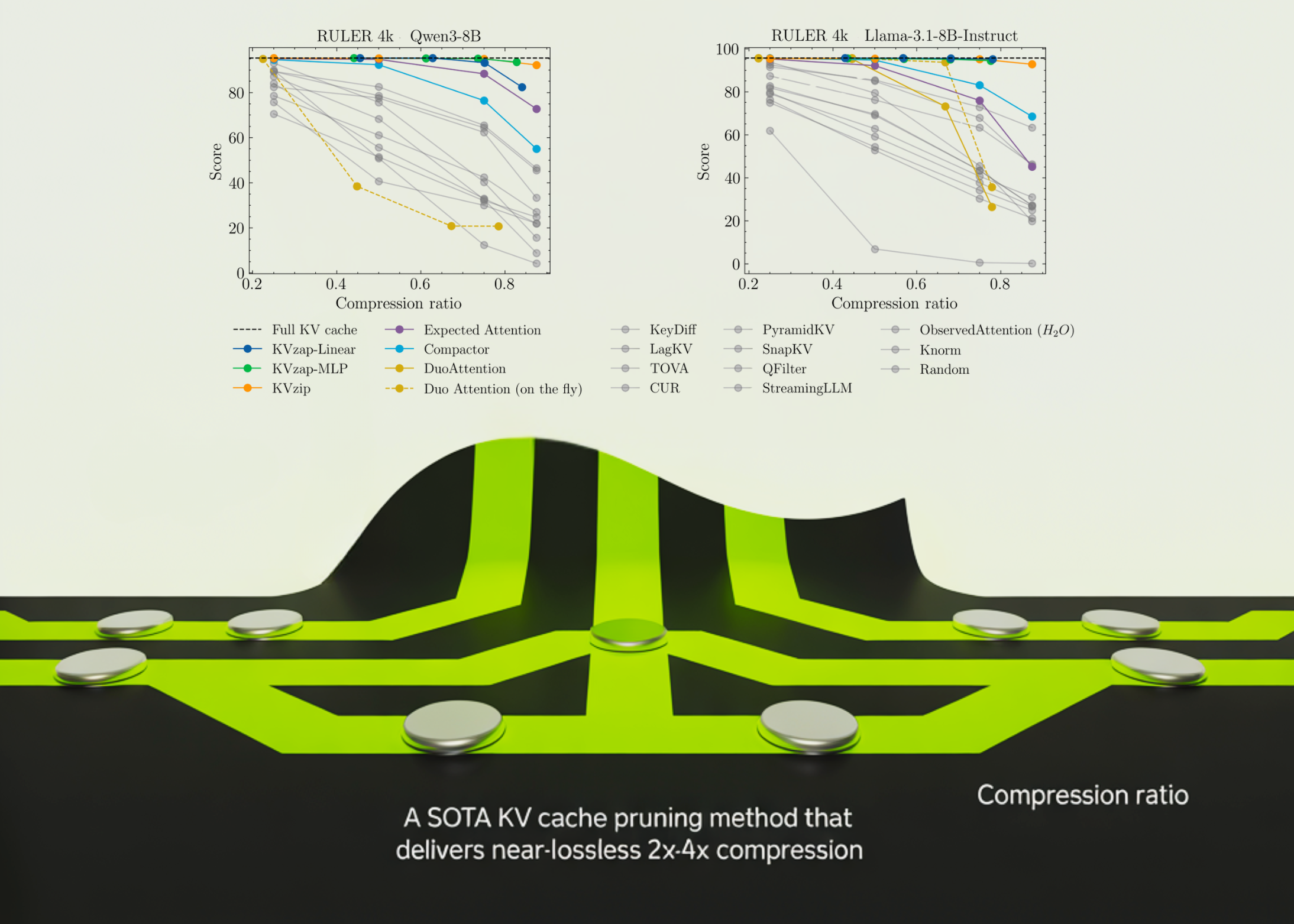
  • NVIDIA just open-sourced KVzap, tackling one of the biggest headaches in deploying long-context LLMs — the memory-hungry KV cache. Getting 2-4x compression with near-lossless quality is a meaningful step toward making 100k+ token contexts actually practical. Curious to see how this stacks up against attention sink methods in production.
    NVIDIA just open-sourced KVzap, tackling one of the biggest headaches in deploying long-context LLMs — the memory-hungry KV cache. Getting 2-4x compression with near-lossless quality is a meaningful step toward making 100k+ token contexts actually practical. 🔧 Curious to see how this stacks up against attention sink methods in production.
    WWW.MARKTECHPOST.COM
    NVIDIA AI Open-Sourced KVzap: A SOTA KV Cache Pruning Method that Delivers near-Lossless 2x-4x Compression
    As context lengths move into tens and hundreds of thousands of tokens, the key value cache in transformer decoders becomes a primary deployment bottleneck. The cache stores keys and values for every layer and head with shape (2, L, H, T, D). For a vanilla transformer such as Llama1-65B, the cache reaches about 335 GB […] The post NVIDIA AI Open-Sourced KVzap: A SOTA KV Cache Pruning Method that Delivers near-Lossless 2x-4x Compression appeared first on MarkTechPost.
    Love
    1
    0 Commentarios 1 Acciones 76 Views
  • NVIDIA just open-sourced KVzap, tackling one of the biggest headaches in deploying long-context LLMs — the memory-hungry KV cache. Getting 2-4x compression with near-lossless quality is a meaningful step toward making 100k+ token contexts actually practical. Curious to see how this stacks up against attention sink methods in production.
    WWW.MARKTECHPOST.COM
    NVIDIA AI Open-Sourced KVzap: A SOTA KV Cache Pruning Method that Delivers near-Lossless 2x-4x Compression
    As context lengths move into tens and hundreds of thousands of tokens, the key value cache in transformer decoders becomes a primary deployment bottleneck. The cache stores keys and values for every layer and head with shape (2, L, H, T, D). For a vanilla transformer such as Llama1-65B, the cache reaches about 335 GB […] The post NVIDIA AI Open-Sourced KVzap: A SOTA KV Cache Pruning Method that Delivers near-Lossless 2x-4x Compression appeared first on MarkTechPost.
    Love
    1
    0 Commentarios 0 Acciones 32 Views
  • Major shift in the global semiconductor landscape: Taiwan agrees to a $250B investment in US chip manufacturing in exchange for tariff relief. This could reshape where the next generation of AI hardware gets built—and who controls the supply chain that powers everything from data centers to consumer devices.
    Major shift in the global semiconductor landscape: Taiwan agrees to a $250B investment in US chip manufacturing in exchange for tariff relief. 🔄 This could reshape where the next generation of AI hardware gets built—and who controls the supply chain that powers everything from data centers to consumer devices.
    WWW.THEVERGE.COM
    The US claims it just strongarmed Taiwan into spending $250 billion on American chip manufacturing
    The US just lowered Taiwan's tariffs in exchange for a massive domestic chipmaking promise, the Commerce Department announced on Thursday. Under the deal, tariffs on goods from Taiwan will decrease from 20 to 15 percent, while Taiwanese technology companies will invest $250 billion into building and expanding chipmaking facilities in the US, supported by at […]
    Haha
    1
    0 Commentarios 1 Acciones 79 Views
  • Major shift in the global semiconductor landscape: Taiwan agrees to a $250B investment in US chip manufacturing in exchange for tariff relief. This could reshape where the next generation of AI hardware gets built—and who controls the supply chain that powers everything from data centers to consumer devices.
    WWW.THEVERGE.COM
    The US claims it just strongarmed Taiwan into spending $250 billion on American chip manufacturing
    The US just lowered Taiwan's tariffs in exchange for a massive domestic chipmaking promise, the Commerce Department announced on Thursday. Under the deal, tariffs on goods from Taiwan will decrease from 20 to 15 percent, while Taiwanese technology companies will invest $250 billion into building and expanding chipmaking facilities in the US, supported by at […]
    Haha
    1
    0 Commentarios 0 Acciones 37 Views
Zubnet https://www.zubnet.com