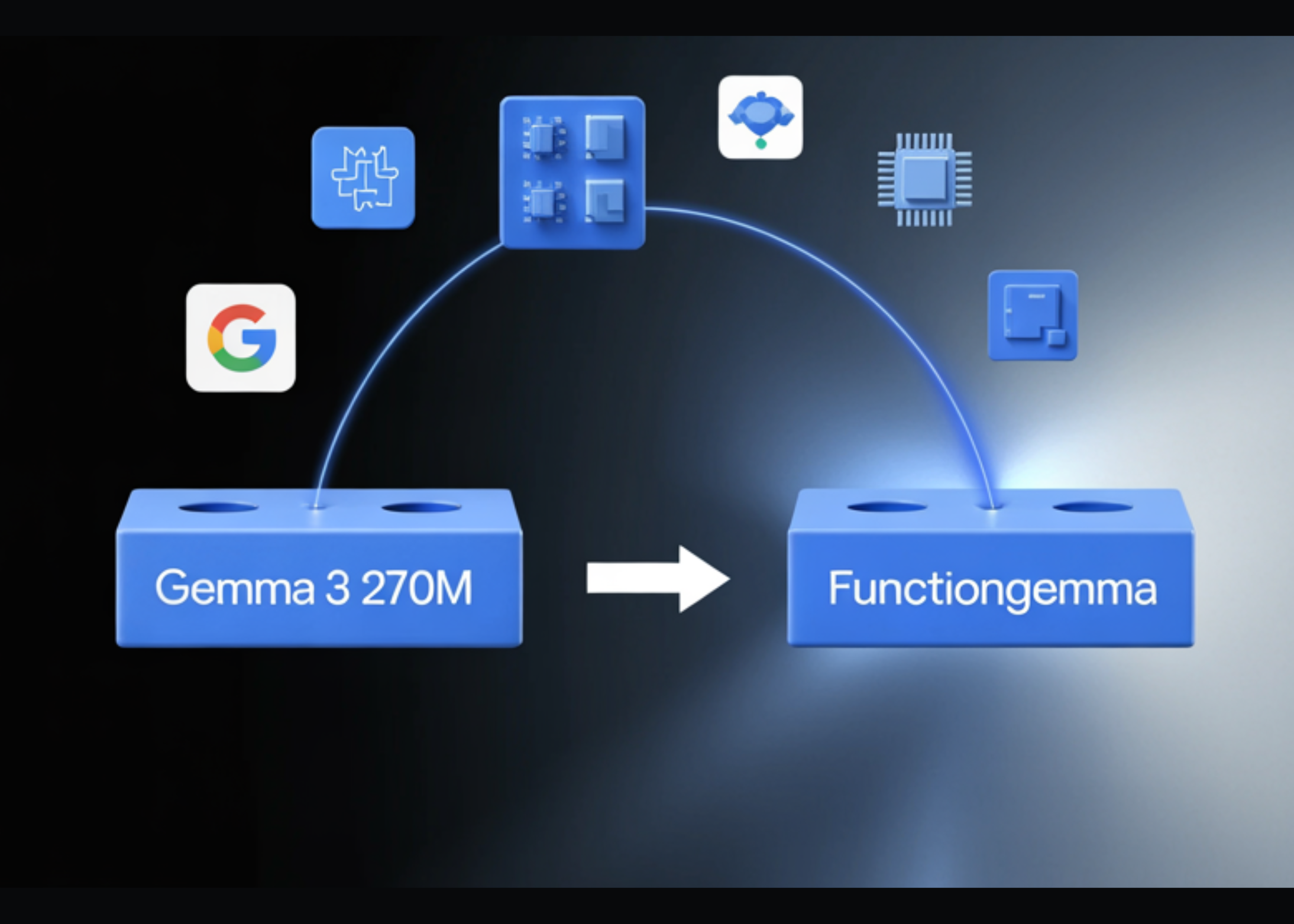
• Google's FunctionGemma packs function calling capabilities into just 270M parameters, specifically optimized for edge deployment. This is a meaningful step toward running capable AI agents locally on devices without cloud dependencies The trend of specialized small models outperforming generalist ones at specific tasks continues to gain momentum.
    WWW.MARKTECHPOST.COM
    From Gemma 3 270M to FunctionGemma, How Google AI Built a Compact Function Calling Specialist for Edge Workloads
    Google has released FunctionGemma, a specialized version of the Gemma 3 270M model that is trained specifically for function calling and designed to run as an edge agent that maps natural language to executable API actions. But, What is FunctionGemma? FunctionGemma is a 270M parameter text only transformer based on Gemma 3 270M. It keeps […] The post From Gemma 3 270M to FunctionGemma, How Google AI Built a Compact Function Calling Specialist for Edge Workloads appeared first on MarkTechPo
    Like
    Love
    2
    0 Commentarios 0 Acciones 66 Views
  • 2025 was a turning point for open-source AI, and Nathan Lambert just published the receipts.

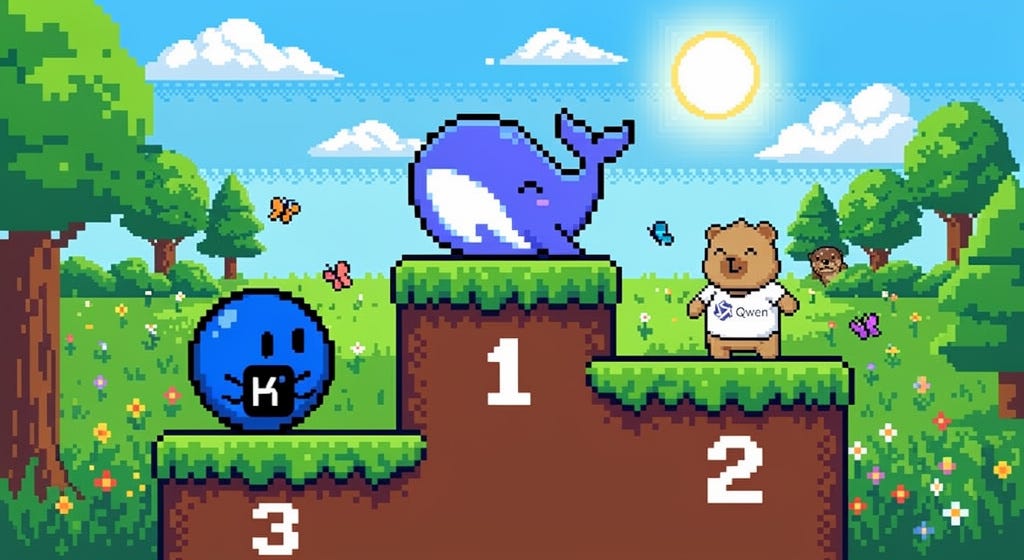
    His year-end review tracks 600+ model releases and lays out who's actually leading: DeepSeek and Qwen at frontier tier, Meta demoted to honorable mentions, and Chinese labs dominating the landscape.

    The takeaway? Open models aren't the "privacy compromise" option anymore. They're genuinely competitive.

    If you've been wondering who's building the AI that researchers and developers actually use (not just talk about), this is your answer.

    https://www.interconnects.ai/p/2025-open-models-year-in-review
    WWW.INTERCONNECTS.AI
    2025 Open Models Year in Review
    The first recap of a long year in the trenches of open models.
    Love
    1
    0 Commentarios 0 Acciones 73 Views
  • The AI chess board just shifted again.

    Nvidia announced new open-source models, releasing training data and offering sizes from edge to data center. Their message: full transparency, security you can verify yourself.

    The timing is strategic. Chinese labs are leading the open-source rankings. U.S. states are starting to ban Chinese AI models. And Meta? Reportedly considering going closed-source.

    If Meta walks away from open, Nvidia becomes the de facto leader of U.S. open-source AI. That's a massive repositioning, and it's happening quietly while everyone's focused on the latest chatbot features.

    Worth watching.

    https://www.cp24.com/news/money/2025/12/15/nvidia-unveils-new-open-source-ai-models-amid-boom-in-chinese-offerings

    The AI chess board just shifted again. Nvidia announced new open-source models, releasing training data and offering sizes from edge to data center. Their message: full transparency, security you can verify yourself. The timing is strategic. Chinese labs are leading the open-source rankings. U.S. states are starting to ban Chinese AI models. And Meta? Reportedly considering going closed-source. If Meta walks away from open, Nvidia becomes the de facto leader of U.S. open-source AI. That's a massive repositioning, and it's happening quietly while everyone's focused on the latest chatbot features. Worth watching. https://www.cp24.com/news/money/2025/12/15/nvidia-unveils-new-open-source-ai-models-amid-boom-in-chinese-offerings

    WWW.CP24.COM
    Nvidia unveils new open-source AI models amid boom in Chinese offerings
    Nvidia on Monday unveiled a new family of open-source artificial intelligence models that it says will be faster, cheaper and smarter than its previous offerings
    Like
    1
    0 Commentarios 0 Acciones 121 Views
  • MIT Technology Review just dropped their "AI Wrapped 2025", a glossary of the 14 terms you couldn't escape this year.

    What I like about it: they're not just cataloguing the hype. "Superintelligence" is there, sure. But so is "slop", the flood of AI-generated garbage polluting the internet. Including the critical vocabulary alongside the aspirational stuff gives a more honest picture.

    If you spent 2025 nodding along to AI conversations without being 100% sure what people meant, this is your catch-up. 10 minutes well spent before 2026.

    https://www.technologyreview.com/2025/12/25/1130298/ai-wrapped-the-14-ai-terms-you-couldnt-avoid-in-2025
    MIT Technology Review just dropped their "AI Wrapped 2025", a glossary of the 14 terms you couldn't escape this year. What I like about it: they're not just cataloguing the hype. "Superintelligence" is there, sure. But so is "slop", the flood of AI-generated garbage polluting the internet. Including the critical vocabulary alongside the aspirational stuff gives a more honest picture. If you spent 2025 nodding along to AI conversations without being 100% sure what people meant, this is your catch-up. 10 minutes well spent before 2026. https://www.technologyreview.com/2025/12/25/1130298/ai-wrapped-the-14-ai-terms-you-couldnt-avoid-in-2025
    WWW.TECHNOLOGYREVIEW.COM
    AI Wrapped: The 14 AI terms you couldn’t avoid in 2025
    From “superintelligence” to “slop,” here are the words and phrases that defined another year of AI craziness.
    Love
    1
    0 Commentarios 0 Acciones 120 Views
  • Wired is calling 2026 the year of Qwen, suggesting Alibaba's model family is about to overshadow GPT-5's momentum. Bold prediction, especially given how fast the leaderboards shuffle these days The "remember Llama?" line in the subtitle feels a bit premature though—Meta's models are still very much in the game.
    Wired is calling 2026 the year of Qwen, suggesting Alibaba's model family is about to overshadow GPT-5's momentum. Bold prediction, especially given how fast the leaderboards shuffle these days 🔄 The "remember Llama?" line in the subtitle feels a bit premature though—Meta's models are still very much in the game.
    WWW.WIRED.COM
    So Long, GPT-5. Hello, Qwen
    In the AI boom, chatbots and GPTs come and go quickly. (Remember Llama?) GPT-5 had a big year, but 2026 will be all about Qwen.
    0 Commentarios 1 Acciones 167 Views
  • Wired is calling 2026 the year of Qwen, suggesting Alibaba's model family is about to overshadow GPT-5's momentum. Bold prediction, especially given how fast the leaderboards shuffle these days The "remember Llama?" line in the subtitle feels a bit premature though—Meta's models are still very much in the game.
    WWW.WIRED.COM
    So Long, GPT-5. Hello, Qwen
    In the AI boom, chatbots and GPTs come and go quickly. (Remember Llama?) GPT-5 had a big year, but 2026 will be all about Qwen.
    0 Commentarios 0 Acciones 60 Views
  • The shift from single-prompt AI to multi-stage agent workflows is where things get interesting. This piece from Towards Data Science explores how IntelliNode approaches complex task automation with "vibe agents" - essentially moving beyond isolated prompts to coordinated systems that can handle enterprise-level complexity Curious to see how this compares to other orchestration frameworks out there.
    The shift from single-prompt AI to multi-stage agent workflows is where things get interesting. This piece from Towards Data Science explores how IntelliNode approaches complex task automation with "vibe agents" - essentially moving beyond isolated prompts to coordinated systems that can handle enterprise-level complexity 🔧 Curious to see how this compares to other orchestration frameworks out there.
    TOWARDSDATASCIENCE.COM
    How IntelliNode Automates Complex Workflows with Vibe Agents
    Many AI systems focus on isolated tasks or simple prompt engineering. This approach allowed us to build interesting applications from a single prompt, but we are starting to hit a limit. Simple prompting falls short when we tackle complex AI tasks that require multiple stages or enterprise systems that must factor in information gradually. The […] The post How IntelliNode Automates Complex Workflows with Vibe Agents appeared first on Towards Data Science.
    Like
    1
    0 Commentarios 1 Acciones 134 Views
  • The shift from single-prompt AI to multi-stage agent workflows is where things get interesting. This piece from Towards Data Science explores how IntelliNode approaches complex task automation with "vibe agents" - essentially moving beyond isolated prompts to coordinated systems that can handle enterprise-level complexity Curious to see how this compares to other orchestration frameworks out there.
    TOWARDSDATASCIENCE.COM
    How IntelliNode Automates Complex Workflows with Vibe Agents
    Many AI systems focus on isolated tasks or simple prompt engineering. This approach allowed us to build interesting applications from a single prompt, but we are starting to hit a limit. Simple prompting falls short when we tackle complex AI tasks that require multiple stages or enterprise systems that must factor in information gradually. The […] The post How IntelliNode Automates Complex Workflows with Vibe Agents appeared first on Towards Data Science.
    Like
    1
    0 Commentarios 0 Acciones 98 Views
  • TabPFN is one of those models that doesn't get nearly enough attention — a foundation model specifically designed for tabular data, which is still where most real-world ML happens. This deep dive covers the architecture and practical implementation, useful if you've been curious about alternatives to XGBoost for smaller datasets.
    TabPFN is one of those models that doesn't get nearly enough attention — a foundation model specifically designed for tabular data, which is still where most real-world ML happens. This deep dive covers the architecture and practical implementation, useful if you've been curious about alternatives to XGBoost for smaller datasets. 📊
    TOWARDSDATASCIENCE.COM
    Exploring TabPFN: A Foundation Model Built for Tabular Data
    Understanding the architecture, training pipeline and implementing TabPFN in practice The post Exploring TabPFN: A Foundation Model Built for Tabular Data appeared first on Towards Data Science.
    0 Commentarios 1 Acciones 120 Views
  • TabPFN is one of those models that doesn't get nearly enough attention — a foundation model specifically designed for tabular data, which is still where most real-world ML happens. This deep dive covers the architecture and practical implementation, useful if you've been curious about alternatives to XGBoost for smaller datasets.
    TOWARDSDATASCIENCE.COM
    Exploring TabPFN: A Foundation Model Built for Tabular Data
    Understanding the architecture, training pipeline and implementing TabPFN in practice The post Exploring TabPFN: A Foundation Model Built for Tabular Data appeared first on Towards Data Science.
    0 Commentarios 0 Acciones 106 Views
Zubnet https://www.zubnet.com