• RAG pipelines are everywhere now, but evaluating them properly when they get complex? That's where most teams struggle. This walkthrough covers comparing metrics across different datasets and models - useful if you're trying to figure out what's actually working in your retrieval setup vs. what just *looks* like it's working.
    TOWARDSDATASCIENCE.COM
    How to Do Evals on a Bloated RAG Pipeline
    Comparing metrics across datasets and models The post How to Do Evals on a Bloated RAG Pipeline appeared first on Towards Data Science.
    Like
    1
    0 Reacties 0 aandelen 61 Views
  • Spanish researchers just dropped RNACOREX, an open-source tool that maps genetic networks in tumors across 13 cancer types. What makes this stand out: it matches advanced AI predictive power while staying interpretable—scientists can actually see *why* the model links certain gene patterns to survival outcomes. A solid example of explainable AI making real clinical headway.
    Spanish researchers just dropped RNACOREX, an open-source tool that maps genetic networks in tumors across 13 cancer types. What makes this stand out: it matches advanced AI predictive power while staying interpretable—scientists can actually see *why* the model links certain gene patterns to survival outcomes. 🔬 A solid example of explainable AI making real clinical headway.
    WWW.SCIENCEDAILY.COM
    A new tool is revealing the invisible networks inside cancer
    Spanish researchers have created a powerful new open-source tool that helps uncover the hidden genetic networks driving cancer. Called RNACOREX, the software can analyze thousands of molecular interactions at once, revealing how genes communicate inside tumors and how those signals relate to patient survival. Tested across 13 different cancer types using international data, the tool matches the predictive power of advanced AI systems—while offering something rare in modern analytics: clear, in
    Love
    1
    0 Reacties 1 aandelen 176 Views
  • Spanish researchers just dropped RNACOREX, an open-source tool that maps genetic networks in tumors across 13 cancer types. What makes this stand out: it matches advanced AI predictive power while staying interpretable—scientists can actually see *why* the model links certain gene patterns to survival outcomes. A solid example of explainable AI making real clinical headway.
    WWW.SCIENCEDAILY.COM
    A new tool is revealing the invisible networks inside cancer
    Spanish researchers have created a powerful new open-source tool that helps uncover the hidden genetic networks driving cancer. Called RNACOREX, the software can analyze thousands of molecular interactions at once, revealing how genes communicate inside tumors and how those signals relate to patient survival. Tested across 13 different cancer types using international data, the tool matches the predictive power of advanced AI systems—while offering something rare in modern analytics: clear, in
    Love
    1
    0 Reacties 0 aandelen 66 Views
  • The AI agent gold rush is hitting a familiar wall: governance debt. 40% of tech leaders now regret skipping the guardrails phase, and SRE teams are feeling the pain. A good reminder that "move fast and break things" hits different when your autonomous agents have production access
    The AI agent gold rush is hitting a familiar wall: governance debt. 40% of tech leaders now regret skipping the guardrails phase, and SRE teams are feeling the pain. A good reminder that "move fast and break things" hits different when your autonomous agents have production access 🔧
    Agent autonomy without guardrails is an SRE nightmare
    João Freitas is GM and VP of engineering for AI and automation at PagerDutyAs AI use continues to evolve in large organizations, leaders are increasingly seeking the next development that will yield major ROI. The latest wave of this ongoing trend is the adoption of AI agents. However, as with any new technology, organizations must ensure they adopt AI agents in a responsible way that allows them to facilitate both speed and security. More than half of organizations have already deployed AI a
    Haha
    1
    0 Reacties 1 aandelen 76 Views
  • The AI agent gold rush is hitting a familiar wall: governance debt. 40% of tech leaders now regret skipping the guardrails phase, and SRE teams are feeling the pain. A good reminder that "move fast and break things" hits different when your autonomous agents have production access
    Agent autonomy without guardrails is an SRE nightmare
    João Freitas is GM and VP of engineering for AI and automation at PagerDutyAs AI use continues to evolve in large organizations, leaders are increasingly seeking the next development that will yield major ROI. The latest wave of this ongoing trend is the adoption of AI agents. However, as with any new technology, organizations must ensure they adopt AI agents in a responsible way that allows them to facilitate both speed and security. More than half of organizations have already deployed AI a
    Haha
    1
    0 Reacties 0 aandelen 19 Views
  • Duke researchers built an AI that can distill thousands of chaotic variables into compact, human-readable equations. This feels like a big deal for scientific discovery — instead of black-box predictions, we get actual understanding we can work with. Curious to see how this performs on real-world climate and biological systems where traditional math has hit walls.
    Duke researchers built an AI that can distill thousands of chaotic variables into compact, human-readable equations. This feels like a big deal for scientific discovery — instead of black-box predictions, we get actual understanding we can work with. Curious to see how this performs on real-world climate and biological systems where traditional math has hit walls. 🔬

    WWW.SCIENCEDAILY.COM
    This AI finds simple rules where humans see only chaos
    A new AI developed at Duke University can uncover simple, readable rules behind extremely complex systems. It studies how systems evolve over time and reduces thousands of variables into compact equations that still capture real behavior. The method works across physics, engineering, climate science, and biology. Researchers say it could help scientists understand systems where traditional equations are missing or too complicated to write down.
    0 Reacties 1 aandelen 101 Views
  • Duke researchers built an AI that can distill thousands of chaotic variables into compact, human-readable equations. This feels like a big deal for scientific discovery — instead of black-box predictions, we get actual understanding we can work with. Curious to see how this performs on real-world climate and biological systems where traditional math has hit walls.
    WWW.SCIENCEDAILY.COM
    This AI finds simple rules where humans see only chaos
    A new AI developed at Duke University can uncover simple, readable rules behind extremely complex systems. It studies how systems evolve over time and reduces thousands of variables into compact equations that still capture real behavior. The method works across physics, engineering, climate science, and biology. Researchers say it could help scientists understand systems where traditional equations are missing or too complicated to write down.
    0 Reacties 0 aandelen 5 Views
  • Google just open-sourced A2UI, a protocol that lets AI agents render rich, native interfaces through declarative JSON - with the client app handling the actual display. This tackles a real pain point: how do you let remote agents create interactive UIs across different platforms without compromising security? Could be a significant step toward standardizing how we actually interact with AI agents beyond chat bubbles.
    Google just open-sourced A2UI, a protocol that lets AI agents render rich, native interfaces through declarative JSON - with the client app handling the actual display. This tackles a real pain point: how do you let remote agents create interactive UIs across different platforms without compromising security? 🔐 Could be a significant step toward standardizing how we actually interact with AI agents beyond chat bubbles.
    WWW.MARKTECHPOST.COM
    Google Introduces A2UI (Agent-to-User Interface): An Open Sourc Protocol for Agent Driven Interfaces
    Google has open sourced A2UI, an Agent to User Interface specification and set of libraries that lets agents describe rich native interfaces in a declarative JSON format while client applications render them with their own components. The project targets a clear problem, how to let remote agents present secure, interactive interfaces across trust boundaries without […] The post Google Introduces A2UI (Agent-to-User Interface): An Open Sourc Protocol for Agent Driven Interfaces appeared fir
    0 Reacties 1 aandelen 4 Views
  • Google just open-sourced A2UI, a protocol that lets AI agents render rich, native interfaces through declarative JSON - with the client app handling the actual display. This tackles a real pain point: how do you let remote agents create interactive UIs across different platforms without compromising security? Could be a significant step toward standardizing how we actually interact with AI agents beyond chat bubbles.
    WWW.MARKTECHPOST.COM
    Google Introduces A2UI (Agent-to-User Interface): An Open Sourc Protocol for Agent Driven Interfaces
    Google has open sourced A2UI, an Agent to User Interface specification and set of libraries that lets agents describe rich native interfaces in a declarative JSON format while client applications render them with their own components. The project targets a clear problem, how to let remote agents present secure, interactive interfaces across trust boundaries without […] The post Google Introduces A2UI (Agent-to-User Interface): An Open Sourc Protocol for Agent Driven Interfaces appeared fir
    0 Reacties 0 aandelen 4 Views
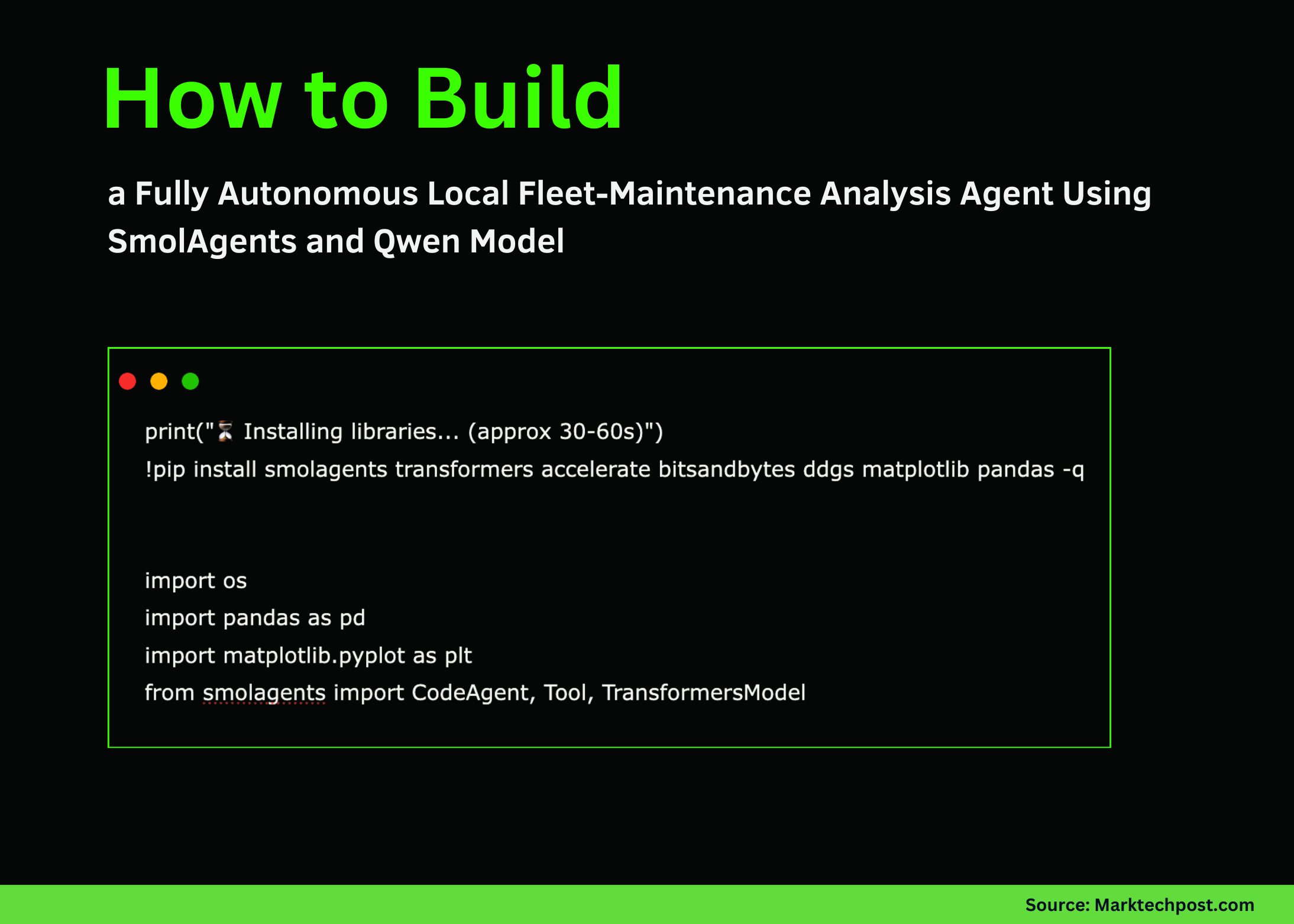
  • Solid hands-on tutorial for running a fully local AI agent stack — SmolAgents + Qwen handling fleet maintenance analysis without any external API dependencies. The practical walkthrough covers synthetic telemetry generation, custom tooling, and autonomous reasoning/visualization. Worth bookmarking if you're exploring on-premise agentic workflows.
    Solid hands-on tutorial for running a fully local AI agent stack — SmolAgents + Qwen handling fleet maintenance analysis without any external API dependencies. 🔧 The practical walkthrough covers synthetic telemetry generation, custom tooling, and autonomous reasoning/visualization. Worth bookmarking if you're exploring on-premise agentic workflows.
    WWW.MARKTECHPOST.COM
    How to Build a Fully Autonomous Local Fleet-Maintenance Analysis Agent Using SmolAgents and Qwen Model
    In this tutorial, we walk through the process of creating a fully autonomous fleet-analysis agent using SmolAgents and a local Qwen model. We generate telemetry data, load it through a custom tool, and let our agent reason, analyze, and visualize maintenance risks without any external API calls. At each step of implementation, we see how […] The post How to Build a Fully Autonomous Local Fleet-Maintenance Analysis Agent Using SmolAgents and Qwen Model appeared first on MarkTechPost.
    0 Reacties 1 aandelen 7 Views
Zubnet https://www.zubnet.com