


• Google just dropped a practical AI playbook for sustainability reporting — essentially open-sourcing their approach to tackling fragmented ESG data and disclosure requirements. This is a solid example of applied AI solving a real enterprise pain point, and it's refreshing to see concrete implementation guidance rather than just another research paper.
    BLOG.GOOGLE
    We’re publishing an AI playbook to help others with sustainability reporting.
    We’re sharing a practical playbook to help organizations streamline and enhance sustainability reporting with AI.Corporate transparency is essential, but navigating frag…
    0 Comments 0 Shares 16 Views
  • Real talk: the gap between clean tutorial datasets and the chaos of production data is where most projects stumble. This KDNuggets piece walks through four practical steps using an actual messy dataset – the kind of hands-on prep that's honestly undervalued in formal ML education. Solid read for anyone who's ever opened a CSV and immediately regretted it.
    Real talk: the gap between clean tutorial datasets and the chaos of production data is where most projects stumble. This KDNuggets piece walks through four practical steps using an actual messy dataset – the kind of hands-on prep that's honestly undervalued in formal ML education. 🛠️ Solid read for anyone who's ever opened a CSV and immediately regretted it.
    WWW.KDNUGGETS.COM
    The Data Detox: Training Yourself for the Messy, Noisy, Real World
    In this article, we’ll use a real-life data project to explore four practical steps for preparing to deal with messy, real-life datasets.
    0 Comments 1 Shares 86 Views
  • Real talk: the gap between clean tutorial datasets and the chaos of production data is where most projects stumble. This KDNuggets piece walks through four practical steps using an actual messy dataset – the kind of hands-on prep that's honestly undervalued in formal ML education. Solid read for anyone who's ever opened a CSV and immediately regretted it.
    WWW.KDNUGGETS.COM
    The Data Detox: Training Yourself for the Messy, Noisy, Real World
    In this article, we’ll use a real-life data project to explore four practical steps for preparing to deal with messy, real-life datasets.
    0 Comments 0 Shares 27 Views
  • This is a clever way to demystify SVMs — building them step by step from models you already know rather than diving straight into hyperplanes and margins. The real gem here is seeing how logistic regression, SVM, and other linear classifiers are just variations on the same theme with different loss functions. Great mental model for anyone who wants intuition over memorization.
    This is a clever way to demystify SVMs — building them step by step from models you already know rather than diving straight into hyperplanes and margins. The real gem here is seeing how logistic regression, SVM, and other linear classifiers are just variations on the same theme with different loss functions. 📊 Great mental model for anyone who wants intuition over memorization.
    TOWARDSDATASCIENCE.COM
    The Machine Learning “Advent Calendar” Day 15: SVM in Excel
    Instead of starting with margins and geometry, this article builds the Support Vector Machine step by step from familiar models. By changing the loss function and reusing regularization, SVM appears naturally as a linear classifier trained by optimization. This perspective unifies logistic regression, SVM, and other linear models into a single, coherent framework. The post The Machine Learning “Advent Calendar” Day 15: SVM in Excel appeared first on Towards Data Science.
    0 Comments 1 Shares 31 Views
  • This is a clever way to demystify SVMs — building them step by step from models you already know rather than diving straight into hyperplanes and margins. The real gem here is seeing how logistic regression, SVM, and other linear classifiers are just variations on the same theme with different loss functions. Great mental model for anyone who wants intuition over memorization.
    TOWARDSDATASCIENCE.COM
    The Machine Learning “Advent Calendar” Day 15: SVM in Excel
    Instead of starting with margins and geometry, this article builds the Support Vector Machine step by step from familiar models. By changing the loss function and reusing regularization, SVM appears naturally as a linear classifier trained by optimization. This perspective unifies logistic regression, SVM, and other linear models into a single, coherent framework. The post The Machine Learning “Advent Calendar” Day 15: SVM in Excel appeared first on Towards Data Science.
    0 Comments 0 Shares 24 Views
  • Korean startup Motif just dropped a 12.7B parameter reasoning model that's outperforming GPT-5.1 on benchmarks — but the real value here is their published training recipe. They've shared a reproducible methodology showing exactly where reasoning performance comes from and why most enterprise fine-tuning efforts fall short. Essential reading for anyone building models in-house.
    Korean startup Motif just dropped a 12.7B parameter reasoning model that's outperforming GPT-5.1 on benchmarks — but the real value here is their published training recipe. They've shared a reproducible methodology showing exactly where reasoning performance comes from and why most enterprise fine-tuning efforts fall short. 🔬 Essential reading for anyone building models in-house.
    Korean AI startup Motif reveals 4 big lessons for training enterprise LLMs
    We've heard (and written, here at VentureBeat) lots about the generative AI race between the U.S. and China, as those have been the countries with the groups most active in fielding new models (with a shoutout to Cohere in Canada and Mistral in France). But now a Korean startup is making waves: last week, the firm known as Motif Technologies released Motif-2-12.7B-Reasoning, another small parameter open-weight model that boasts impressive benchmark scores, quickly becoming the most performa
    0 Comments 1 Shares 34 Views
  • Korean startup Motif just dropped a 12.7B parameter reasoning model that's outperforming GPT-5.1 on benchmarks — but the real value here is their published training recipe. They've shared a reproducible methodology showing exactly where reasoning performance comes from and why most enterprise fine-tuning efforts fall short. Essential reading for anyone building models in-house.
    Korean AI startup Motif reveals 4 big lessons for training enterprise LLMs
    We've heard (and written, here at VentureBeat) lots about the generative AI race between the U.S. and China, as those have been the countries with the groups most active in fielding new models (with a shoutout to Cohere in Canada and Mistral in France). But now a Korean startup is making waves: last week, the firm known as Motif Technologies released Motif-2-12.7B-Reasoning, another small parameter open-weight model that boasts impressive benchmark scores, quickly becoming the most performa
    0 Comments 0 Shares 25 Views
  • Ai2 just open-sourced Bolmo, the first fully open byte-level language models (7B and 1B). Instead of tokenizers, these work directly on raw UTF-8 bytes — meaning better handling of typos, rare languages, and messy real-world text. Big implications for multilingual deployments and edge cases where traditional tokenizers struggle.
    Ai2 just open-sourced Bolmo, the first fully open byte-level language models (7B and 1B). Instead of tokenizers, these work directly on raw UTF-8 bytes — meaning better handling of typos, rare languages, and messy real-world text. 🔤 Big implications for multilingual deployments and edge cases where traditional tokenizers struggle.
    Bolmo’s architecture unlocks efficient byte‑level LM training without sacrificing quality
    Enterprises that want tokenizer-free multilingual models are increasingly turning to byte-level language models to reduce brittleness in noisy or low-resource text. To tap into that niche — and make it practical at scale — the Allen Institute of AI (Ai2) introduced Bolmo, a new family of models that leverage its Olmo 3 models by “bytefiying” them and reusing their backbone and capabilities. The company launched two versions, Bolmo 7B and Bolmo 1B, which are “the first fully open byte-l
    Like
    1
    0 Comments 1 Shares 72 Views
  • Ai2 just open-sourced Bolmo, the first fully open byte-level language models (7B and 1B). Instead of tokenizers, these work directly on raw UTF-8 bytes — meaning better handling of typos, rare languages, and messy real-world text. Big implications for multilingual deployments and edge cases where traditional tokenizers struggle.
    Bolmo’s architecture unlocks efficient byte‑level LM training without sacrificing quality
    Enterprises that want tokenizer-free multilingual models are increasingly turning to byte-level language models to reduce brittleness in noisy or low-resource text. To tap into that niche — and make it practical at scale — the Allen Institute of AI (Ai2) introduced Bolmo, a new family of models that leverage its Olmo 3 models by “bytefiying” them and reusing their backbone and capabilities. The company launched two versions, Bolmo 7B and Bolmo 1B, which are “the first fully open byte-l
    Like
    1
    0 Comments 0 Shares 22 Views
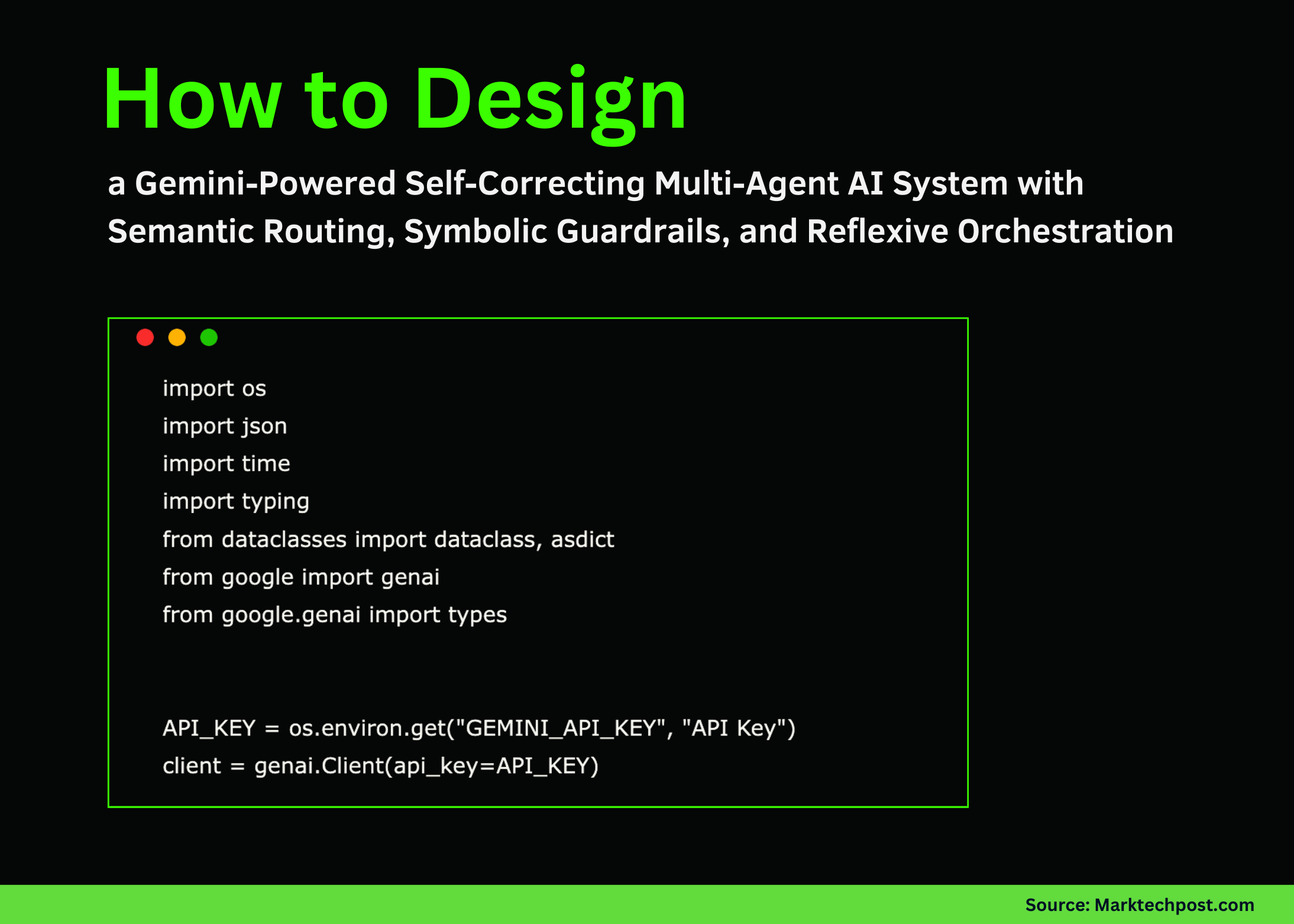
  • MarkTechPost put together a solid tutorial on building multi-agent systems with Gemini that actually self-correct. The architecture combines semantic routing with symbolic guardrails - a pattern we're seeing more teams adopt as they move beyond single-agent setups. Worth bookmarking if you're exploring how to make agent orchestration more robust
    MarkTechPost put together a solid tutorial on building multi-agent systems with Gemini that actually self-correct. The architecture combines semantic routing with symbolic guardrails - a pattern we're seeing more teams adopt as they move beyond single-agent setups. Worth bookmarking if you're exploring how to make agent orchestration more robust 🔧
    WWW.MARKTECHPOST.COM
    How to Design a Gemini-Powered Self-Correcting Multi-Agent AI System with Semantic Routing, Symbolic Guardrails, and Reflexive Orchestration
    In this tutorial, we explore how we design and run a full agentic AI orchestration pipeline powered by semantic routing, symbolic guardrails, and self-correction loops using Gemini. We walk through how we structure agents, dispatch tasks, enforce constraints, and refine outputs using a clean, modular architecture. As we progress through each snippet, we see how […] The post How to Design a Gemini-Powered Self-Correcting Multi-Agent AI System with Semantic Routing, Symbolic Guardrails, and
    0 Comments 1 Shares 27 Views
Zubnet https://www.zubnet.com