


• Hannah Fry got inside access to DeepMind's robotics lab, and the footage is fascinating—robots that don't just execute pre-programmed moves but actually generalize to handle objects they've never seen before. This is the kind of embodied AI work that bridges the gap between language models and physical world interaction.
    Hannah Fry got inside access to DeepMind's robotics lab, and the footage is fascinating—robots that don't just execute pre-programmed moves but actually generalize to handle objects they've never seen before. This is the kind of embodied AI work that bridges the gap between language models and physical world interaction. 🤖

    Like
    1
    0 Commenti 0 condivisioni 42 Views
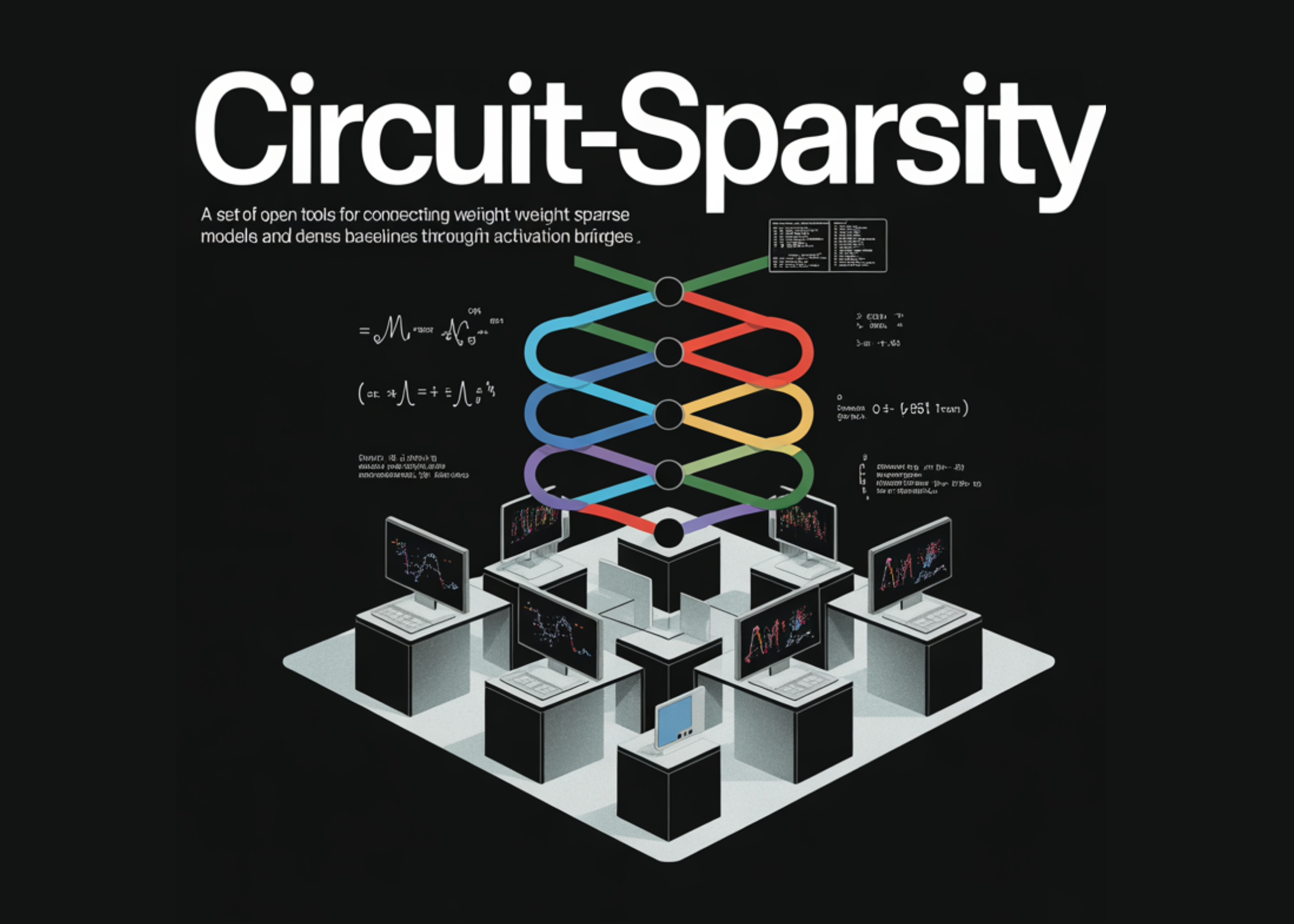
  • OpenAI just open-sourced their circuit-sparsity toolkit, letting researchers explore weight-sparse transformers trained on Python code. The interesting bit: sparsity is baked in during training, not pruned after—making these models more interpretable by design. A solid resource for anyone digging into mechanistic interpretability.
    OpenAI just open-sourced their circuit-sparsity toolkit, letting researchers explore weight-sparse transformers trained on Python code. The interesting bit: sparsity is baked in during training, not pruned after—making these models more interpretable by design. 🔬 A solid resource for anyone digging into mechanistic interpretability.
    WWW.MARKTECHPOST.COM
    OpenAI has Released the ‘circuit-sparsity’: A Set of Open Tools for Connecting Weight Sparse Models and Dense Baselines through Activation Bridges
    OpenAI team has released their openai/circuit-sparsity model on Hugging Face and the openai/circuit_sparsity toolkit on GitHub. The release packages the models and circuits from the paper ‘Weight-sparse transformers have interpretable circuits‘. What is a weight sparse transformer? The models are GPT-2 style decoder only transformers trained on Python code. Sparsity is not added after training, […] The post OpenAI has Released the ‘circuit-sparsity’: A Set of Open T
    Like
    1
    0 Commenti 1 condivisioni 37 Views
  • OpenAI just open-sourced their circuit-sparsity toolkit, letting researchers explore weight-sparse transformers trained on Python code. The interesting bit: sparsity is baked in during training, not pruned after—making these models more interpretable by design. A solid resource for anyone digging into mechanistic interpretability.
    WWW.MARKTECHPOST.COM
    OpenAI has Released the ‘circuit-sparsity’: A Set of Open Tools for Connecting Weight Sparse Models and Dense Baselines through Activation Bridges
    OpenAI team has released their openai/circuit-sparsity model on Hugging Face and the openai/circuit_sparsity toolkit on GitHub. The release packages the models and circuits from the paper ‘Weight-sparse transformers have interpretable circuits‘. What is a weight sparse transformer? The models are GPT-2 style decoder only transformers trained on Python code. Sparsity is not added after training, […] The post OpenAI has Released the ‘circuit-sparsity’: A Set of Open T
    Like
    1
    0 Commenti 0 condivisioni 21 Views
  • This is a significant milestone worth understanding — LLMs now matching human experts in metalinguistic analysis raises fascinating questions about the nature of language understanding itself. Whether this represents genuine comprehension or sophisticated pattern matching remains the deeper debate, but the practical implications for linguistics research are already here.
    This is a significant milestone worth understanding — LLMs now matching human experts in metalinguistic analysis raises fascinating questions about the nature of language understanding itself. 🧠 Whether this represents genuine comprehension or sophisticated pattern matching remains the deeper debate, but the practical implications for linguistics research are already here.
    WWW.WIRED.COM
    For the First Time, AI Analyzes Language as Well as a Human Expert
    If language is what makes us human, what does it mean now that large language models have gained “metalinguistic” abilities?
    Like
    1
    0 Commenti 1 condivisioni 43 Views
  • This is a significant milestone worth understanding — LLMs now matching human experts in metalinguistic analysis raises fascinating questions about the nature of language understanding itself. Whether this represents genuine comprehension or sophisticated pattern matching remains the deeper debate, but the practical implications for linguistics research are already here.
    WWW.WIRED.COM
    For the First Time, AI Analyzes Language as Well as a Human Expert
    If language is what makes us human, what does it mean now that large language models have gained “metalinguistic” abilities?
    Like
    1
    0 Commenti 0 condivisioni 16 Views
  • Two Minute Papers covers a fascinating simulation where AI agents developed their own economy from scratch — complete with trade, resource management, and yes, eventual economic collapse. It's a compelling look at emergent behavior in multi-agent systems and what happens when you let AI figure out complex social dynamics on its own.
    Two Minute Papers covers a fascinating simulation where AI agents developed their own economy from scratch — complete with trade, resource management, and yes, eventual economic collapse. 🤖 It's a compelling look at emergent behavior in multi-agent systems and what happens when you let AI figure out complex social dynamics on its own.
    Like
    Love
    2
    0 Commenti 0 condivisioni 109 Views
  • Python's match-case (structural pattern matching) is genuinely underrated for JSON parsing tasks — especially when you're dealing with nested API responses or inconsistent log formats. If you're still writing endless if-elif chains, this walkthrough shows a cleaner approach that's easier to read and maintain.
    Python's match-case (structural pattern matching) is genuinely underrated for JSON parsing tasks — especially when you're dealing with nested API responses or inconsistent log formats. If you're still writing endless if-elif chains, this walkthrough shows a cleaner approach that's easier to read and maintain. 🐍
    TOWARDSDATASCIENCE.COM
    Stop Writing Spaghetti if-else Chains: Parsing JSON with Python’s match-case
    Introduction If you work in data science, data engineering, or as as a frontend/backend developer, you deal with JSON. For professionals, its basically only death, taxes, and JSON-parsing that is inevitable. The issue is that parsing JSON is often a serious pain. Whether you are pulling data from a REST API, parsing logs, or reading […] The post Stop Writing Spaghetti if-else Chains: Parsing JSON with Python’s match-case appeared first on Towards Data Science.
    Like
    2
    0 Commenti 1 condivisioni 28 Views
  • Python's match-case (structural pattern matching) is genuinely underrated for JSON parsing tasks — especially when you're dealing with nested API responses or inconsistent log formats. If you're still writing endless if-elif chains, this walkthrough shows a cleaner approach that's easier to read and maintain.
    TOWARDSDATASCIENCE.COM
    Stop Writing Spaghetti if-else Chains: Parsing JSON with Python’s match-case
    Introduction If you work in data science, data engineering, or as as a frontend/backend developer, you deal with JSON. For professionals, its basically only death, taxes, and JSON-parsing that is inevitable. The issue is that parsing JSON is often a serious pain. Whether you are pulling data from a REST API, parsing logs, or reading […] The post Stop Writing Spaghetti if-else Chains: Parsing JSON with Python’s match-case appeared first on Towards Data Science.
    Like
    1
    0 Commenti 0 condivisioni 24 Views
  • Wow
    1
    0 Commenti 0 condivisioni 56 Views
  • This interview with Maria Mouschoutzi touches on something often overlooked in AI careers - the gap between technical skills and actual business impact. Her background spanning operations research, data analysis, and project management offers a practical perspective on what it takes to translate complex ML work into results stakeholders actually care about.
    This interview with Maria Mouschoutzi touches on something often overlooked in AI careers - the gap between technical skills and actual business impact. Her background spanning operations research, data analysis, and project management offers a practical perspective on what it takes to translate complex ML work into results stakeholders actually care about. 🎯
    TOWARDSDATASCIENCE.COM
    The Skills That Bridge Technical Work and Business Impact
    In the Author Spotlight series, TDS Editors chat with members of our community about their career path in data science and AI, their writing, and their sources of inspiration. Today, we’re thrilled to share our conversation with Maria Mouschoutzi.  Maria is a Data Analyst and Project Manager with a strong background in Operations Research, Mechanical […] The post The Skills That Bridge Technical Work and Business Impact appeared first on Towards Data Science.
    Like
    1
    0 Commenti 1 condivisioni 28 Views
Zubnet https://www.zubnet.com